

If you are over 45 and you take daily supplements, you have probably stood in the vitamin aisle wondering whether one more bottle is worth it. I know I have. I am Lorraine, and I started reading labels seriously in my mid fifties, after I noticed my afternoon energy dipping in a way it never had before. I am not a doctor and I do not play one in this article. I am a careful label reader who checks with her doctor before adding anything new, and I want to walk you through exactly how I added Nutricost Alpha Lipoic Acid to my routine without overcomplicating it.
Alpha lipoic acid, often called ALA, is a compound your body makes naturally and uses in the mitochondria, the part of the cell that turns nutrients into energy. As we get older, natural levels can decline, which is why so many adults 45 and up look for it in supplement form. The bottle I use is Nutricost Alpha Lipoic Acid, 600 mg per serving, 120 capsules. It is not a treatment for anything, and I am not here to tell you it will fix a diagnosis. What I can tell you is how I fit it into a normal morning routine, what I watched for, and what I would tell a friend who asked.
Start with the exact bottle I use
Nutricost Alpha Lipoic Acid gives you 600 mg per serving in a straightforward 120-capsule bottle. If your doctor has cleared ALA for you, this is the one I reach for every morning.
Amazon Check Today's Price on Amazon →Step 1: Talk to your doctor or pharmacist first
This is the step I never skip, and I want you to take it seriously. Alpha lipoic acid can affect blood sugar, and it interacts with some prescription medications, including certain diabetes drugs. If you take anything for blood sugar, blood pressure, or thyroid function, you need a professional to look at your full medication list before you add ALA. My own doctor reviews my supplement list at my yearly checkup, and I sent her a message before I ordered this bottle. She wrote back within the day and asked which dose I was considering, which is exactly the kind of question you want a professional to ask.
Your pharmacist is another good resource. Pharmacists see drug interactions all day long, and a five minute conversation at the counter can save you from a bad reaction. I did this myself last fall when I was unsure whether ALA would clash with my blood pressure medication. The pharmacist pulled up my list, walked me through each item, and told me that 600 mg was a reasonable place to start as long as I took it with food and watched how I felt. Ask specifically whether ALA is safe with everything you currently take, and ask whether 600 mg is a reasonable place to start for your age and health profile. Write down what they say, because you will want to remember it when you are standing in the aisle later.
If your doctor or pharmacist says no, respect that. There are other ways to support your body, and no supplement is worth a medication conflict. If they say yes, you now have a clear green light, which makes every later step easier. You will also know who to call if anything feels off in the first few weeks, and that peace of mind is worth the five minutes it takes to ask.

Step 2: Pick a consistent time of day
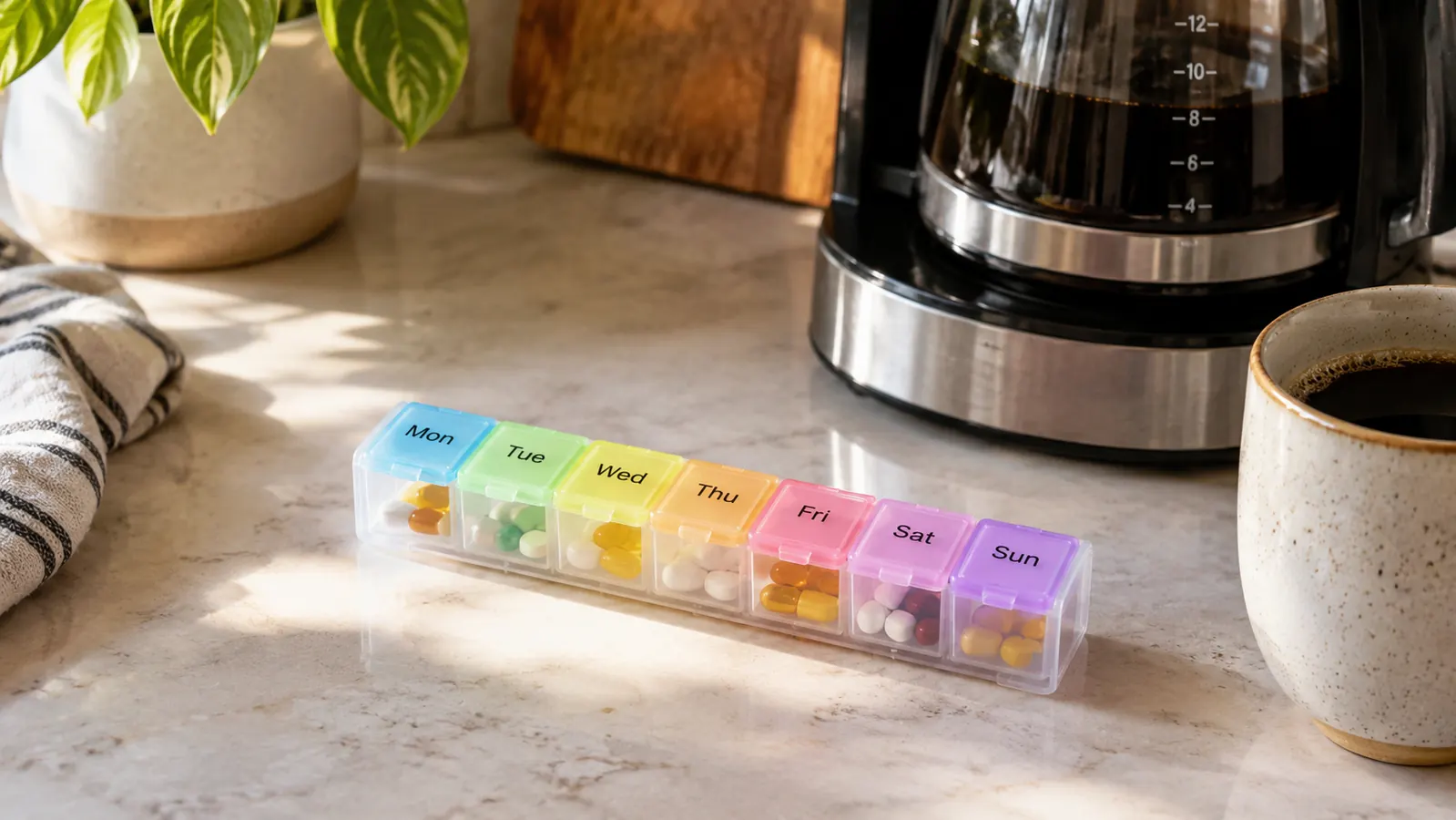
Consistency matters more than perfection. I take my supplements in the morning with breakfast, and I keep them in a weekly pill organizer on the kitchen counter next to the coffee maker. That way, I cannot miss them. ALA is often recommended with a meal, and morning works well for me because it is the same time every single day, including weekends, which is where most routines fall apart.
Some people prefer taking ALA later in the day, and that is fine too. The important thing is to pick a time you will actually remember. If mornings are rushed in your house, put the bottle next to your lunch plate or your dinner spot. If you use a weekly organizer, add the capsules on Sunday night so the week is ready to go. I fill mine every Sunday evening while the coffee maker is still warm from the morning, and it takes less than two minutes.
I will also say this: a routine only works if it fits your life. My husband Ray takes his own supplements at night because that is when he remembers. I take mine in the morning because that is when I remember. We are both consistent, and that is what counts. The exact hour matters far less than the fact that the bottle is sitting somewhere you cannot avoid seeing it.
Step 3: Start with food, not an empty stomach
Take ALA with a meal that contains some fat. I have read enough labels and talked to enough pharmacists to know that fat helps with absorption, and honestly, taking any supplement on an empty stomach has never agreed with me. My morning breakfast is usually oatmeal with nuts and fruit, or eggs and toast, and either one works fine. On the mornings I make oatmeal, I add a spoonful of peanut butter or a handful of walnuts, which gives the capsule something fatty to travel with.
A glass of water with the capsule is obvious but worth saying out loud. Swallow the capsule with a full glass of water, not a sip. If you have trouble swallowing capsules, you can take it with applesauce or yogurt instead, just keep the meal nearby. I keep a glass on the counter next to my organizer, so the water is already there when I reach for the capsule.
What I avoid is taking ALA with coffee alone. Coffee is not a meal, and I want the capsule to land in a stomach that has real food in it. If I am walking my two miles before breakfast, I take the capsule when I get back, with my eggs, not before I leave. I learned that the hard way years ago with another supplement, when I took it on an empty stomach and spent the morning feeling queasy. Now food comes first, always.
Step 4: Start low and keep a simple log
The Nutricost bottle is 600 mg per serving, and that is a common adult dose, but that does not mean you have to start there. If you are new to ALA, consider starting with one capsule every other day for the first week or two, or ask your doctor whether a lower dose is available. I started with one capsule daily because my doctor cleared it, but I still paid close attention to how I felt. For the first ten days, I took it every other day just to be careful, then moved to daily once I knew my stomach was fine with it.
Keep a simple log. It does not need to be fancy. I keep a small notebook in the kitchen drawer, and I write down the date, the dose, whether I took it with food, and how I felt that afternoon. On day four, for example, I wrote took with eggs, felt fine, no change. On day twelve I noted that my usual mid afternoon slump did not show up until later than normal. After a few weeks, you will have a clear record of whether this supplement fits your body. If something feels off, you have the information ready to share with your doctor.
What I watch for: stomach upset, any unusual reaction, or any change in how my usual medications feel. I have not had any of those with Nutricost, but I would stop and call my doctor if I did. A supplement should feel like a quiet addition to your day, not a noticeable event. If you are logging something new every single afternoon, that is information worth bringing to a professional.
Step 5: Give it time and stay consistent
Supplements are not a light switch. I gave ALA a full eight weeks before I formed an opinion, and I think that is the right way to approach it. My afternoon energy has felt steadier since I added it, but I also changed other things in the same window, like drinking more water and walking my two miles more regularly. I cannot untangle which change did what, and I am not going to pretend I can. What I can tell you is that by week six, my 3 p.m. slump had become noticeably milder on most days, and that was enough to keep me going.
What I can say is that the routine itself is easy. One capsule with breakfast, one glass of water, one line in my notebook. The bottle lasts a long time, 120 capsules, so I am not reordering every week. That simplicity is what keeps me consistent, and consistency is what gives a supplement a fair chance. When I opened the bottle in early January, I marked the date on the lid with a permanent marker, and it is still going strong well into spring.
Set a reminder on your phone for the first month if you need it. After thirty days, the habit will feel automatic. And when the bottle runs low, reorder before you run out, because a gap in the routine is harder to restart than it looks. I put a reminder in my phone for the first month, and by the time it stopped, I did not need it anymore.
What Else Helps
Nutricost Alpha Lipoic Acid is one piece of a routine, not the whole routine. I pair it with the basics: a varied diet, a couple of miles of walking most mornings, and enough water. I also take a multivitamin and vitamin D, both cleared by my doctor. If you are looking at ALA because your energy dips in the afternoon, look at your sleep and your lunch too. No capsule replaces a decent night of sleep or a meal that is not mostly refined carbs.
I also want to name the obvious: ALA is not a treatment for any condition, and no supplement should be used that way. It supports normal cellular function, and that is all I am claiming for my own routine. If you have a health concern, your doctor is the person to talk to. My rule is simple: I bring my supplement list to my yearly checkup, and I let a professional look at it before I start anything new.
One capsule with breakfast, a full glass of water, and a line in my notebook. That is the whole routine, and consistency is what gives it a fair chance.
Ready to add ALA to your morning routine?
Nutricost Alpha Lipoic Acid, 600 mg, 120 capsules, is the bottle I keep in my weekly organizer. If your doctor has cleared it, this is a simple place to start.
Amazon Check Today's Price on Amazon →