

I started reading CoQ10 labels seriously about three years ago, right around the time I told Ray that my two-mile morning walk was starting to feel like a four-mile one. I was 55, newly retired from running an elementary school office, and I had finally hit the age where I could not blame a bad night of sleep for every sluggish afternoon. My doctor had mentioned CoQ10 at my yearly checkup, mostly in passing, and said that if I wanted to try a supplement, the form mattered more than most people realized. That comment sent me down a rabbit hole of absorption charts, and it is the reason I ended up with a bottle of Qunol Ubiquinol on my kitchen counter instead of the cheaper CoQ10 I almost grabbed first.
This is not a medical review, and I am not a doctor. I am a 58-year-old former school administrator in Henderson, Nevada, who takes her supplements seriously, reads every label twice, and asks her pharmacist before adding anything new. What follows is what I learned from months of taking Qunol Ubiquinol every morning, what I noticed, what I did not notice, and the questions I think anyone over 45 should ask before they buy.
The Quick Verdict
Qunol Ubiquinol is the supplement I reach for when I want the active form of CoQ10 in a softgel that is easy to swallow and easy to keep in a routine. It is not cheap, it will not fix a bad diet, and you should talk to your doctor first. But after months of daily use, it earns its place in my weekly pill organizer.
Amazon Check Today's Price →Months in, this is the CoQ10 bottle that stayed on my counter
I have tried enough supplements to know that the ones I actually keep taking are the ones that fit into a real morning routine. Qunol Ubiquinol did. Check today's price on Amazon and see if it earns a spot next to your coffee maker too.
Amazon Check Today's Price on Amazon →How I've Used It
I take one softgel of Qunol Ubiquinol 100mg every morning with breakfast, usually a bowl of oatmeal and a glass of orange juice. My rule for any supplement that comes in a softgel is that it goes with food, because that is what the label says and because it is easier on my stomach. The softgel itself is small enough that I do not have to think about swallowing it, which matters more to me than I like to admit.
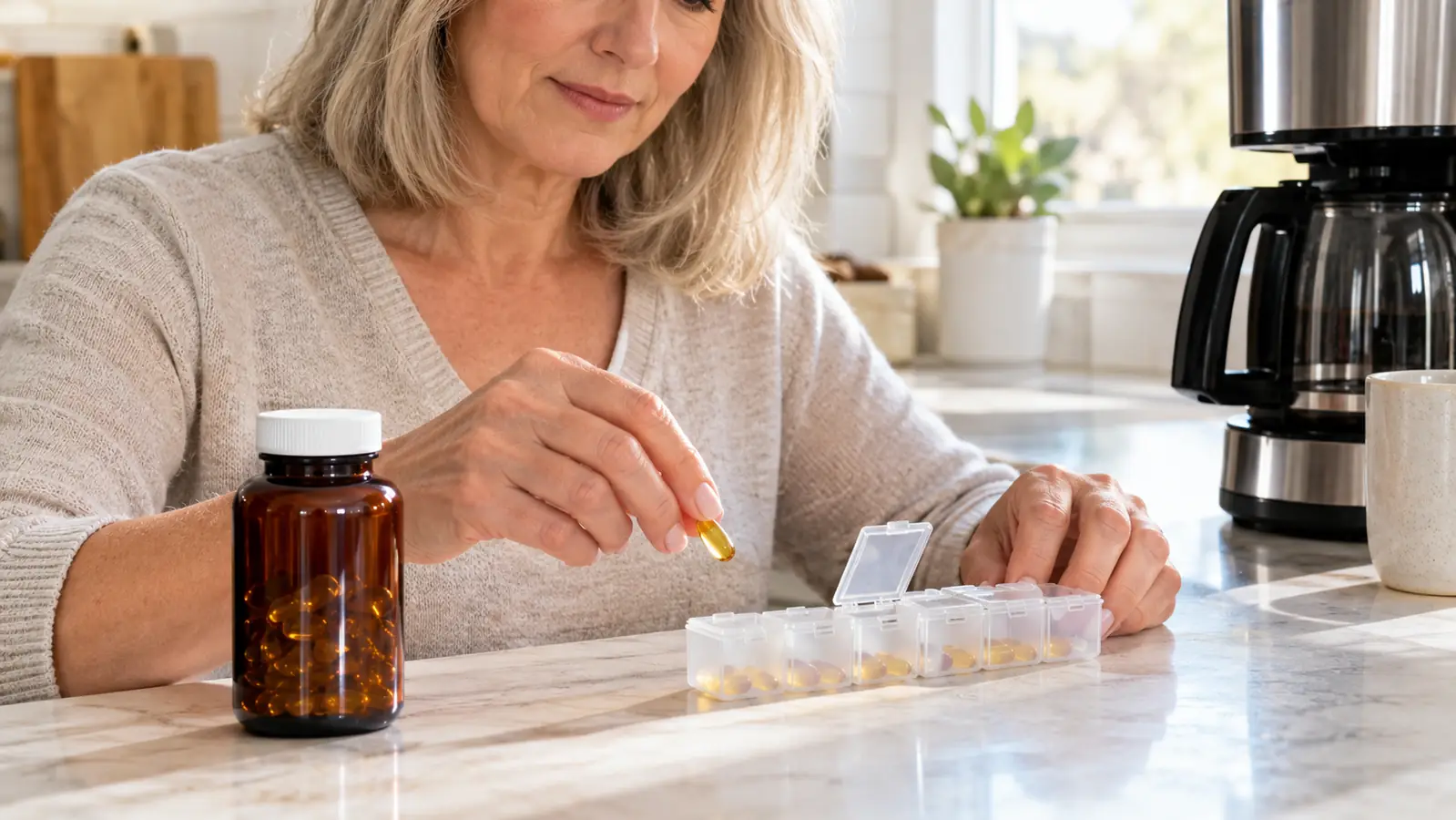
I keep my weekly pill organizer on the kitchen counter next to the coffee maker, so my morning routine is the same every day: coffee first, then breakfast, then the organizer. That routine is the single biggest reason I have actually stuck with this for months. I have bought supplements before that lived in a cabinet and went stale because they were out of sight. Qunol Ubiquinol lives where I can see it, and I take it the same way every single morning.
One thing I want to be honest about: I did not feel a dramatic change in the first week. I know some supplement reviews read like the writer woke up on day three with a new body. That was not my experience. The change I noticed was slower and easier to miss, which is exactly why I kept a rough mental note of how my mornings felt instead of trusting a first impression.
I started on the first Tuesday of October, the day after my yearly checkup, and I wrote the start date on the bottle with a piece of masking tape, the same trick I use for every new supplement. That first bottle lasted about three months, which is how I know I took it consistently instead of letting it sit in the cabinet like so many bottles before it. I also learned something in those first weeks: if I took the softgel on an empty stomach, I felt a little queasy by mid-morning, so the breakfast rule stopped being a suggestion and became a hard rule. Now the oatmeal and the orange juice come first, then the softgel, and I have not had a single upset stomach since.
What CoQ10 and Ubiquinol Actually Are
CoQ10 is a compound your body makes on its own and uses to produce energy at the cellular level. It is found in every cell, and it is especially active in organs with high energy demands, like the heart, the brain, and the muscles you use when you walk two miles before the Nevada sun gets serious. Your body makes less of it as you get older, which is the reason so many adults over 45 end up reading about it in the first place.
The distinction that matters is between ubiquinone and ubiquinol. Standard CoQ10 supplements are usually ubiquinone, the oxidized form. Your body has to convert ubiquinone into ubiquinol, the reduced form, before it can actually use it. That conversion is exactly the step that becomes less efficient with age and with certain medications. Qunol makes both forms, and the ubiquinol version is the one that skips that conversion step entirely.
I am not going to pretend I understood all of this the first time I read it. What finally made it click for me was a comparison my pharmacist made: ubiquinone is like a check you have to deposit before you can spend it, and ubiquinol is cash. Both have value, but one is ready to use right now. For an adult in her late fifties who wanted to give her body the most usable form, Qunol Ubiquinol made sense on paper. Months later, it still makes sense to me.
What I Noticed Over Months of Daily Use
The first thing I noticed, around the three-week mark, was that my afternoon slump was less dramatic. I am a person who used to hit a wall around 2:00 PM, the kind of wall that made me sit down with a second cup of coffee and stare at the wall until my brain came back. That wall got noticeably lower. I would not say I felt like a woman half my age. I would say I felt like myself on a day when I had slept well, and that was enough to make me keep going.
The second thing I noticed was on my morning walks. I walk about two miles most mornings, and I have done it long enough to know which sections feel harder than they should. About six weeks in, I realized I was not dreading the uphill stretch near the golf course the way I usually did. My legs did not feel dramatically stronger. The walk just felt more like the walk I remembered from five years ago, and less like a chore I had to finish before the heat set in.
One specific morning stands out. It was a Thursday in late January, and I had stayed up past midnight the night before helping my daughter pack for a move, the kind of night that used to guarantee a foggy, useless day. I took my softgel with breakfast anyway, walked my two miles, and by noon I realized I had not once reached for the second cup of coffee. One morning is not data, I know that. But it was the first time I caught myself thinking that whatever this supplement was doing, I wanted to keep doing it.
I want to be careful here, because correlation is not causation and I know it. I was also sleeping better during that stretch, eating more vegetables, and taking my walks more consistently. Qunol Ubiquinol was one variable in a routine that I was paying more attention to overall. What I can say honestly is that the supplement did not hurt, it did not upset my stomach, and the months where I took it consistently were the months where my energy felt most even. That is a real observation, even if it is not a laboratory finding.
I would not say I felt like a woman half my age. I would say I felt like myself on a day when I had slept well, and that was enough to make me keep going.
What I Like About Qunol Ubiquinol
The first thing I like is the form itself. Qunol makes ubiquinol, the active form, which means I am not relying on my 58-year-old body to do the conversion work efficiently. I chose Qunol specifically because the brand makes both ubiquinone and ubiquinol, and the label tells you exactly which one you are getting. That kind of clarity is rarer than it should be in the supplement aisle.
The second thing I like is the softgel size. I have a friend who bought a CoQ10 capsule that was so large she dreaded taking it every morning, and she eventually stopped. The Qunol Ubiquinol softgel is small and easy to swallow, which sounds like a minor detail until you have stood at a kitchen counter at 7:00 AM trying to convince yourself to take a pill the size of a grape. I have never once dreaded taking this one.
The third thing I like is the routine fit. The bottle is easy to open, the softgels do not stick together, and the label is easy to read without reading glasses. Qunol also makes a version with 200mg per softgel, so if my doctor ever suggests a higher amount, I can stay with the same brand and the same routine instead of starting over with something new.
Before I settled on Qunol Ubiquinol, I tried a cheaper ubiquinone CoQ10 from a store brand, the kind that sits on the bottom shelf. It was fine, I suppose, but the softgels were large, the bottle was hard to open, and I kept forgetting whether I had taken it because nothing about it stood out. I stopped taking it after about six weeks, not because it did anything wrong, but because it did not fit into my life. That is the real reason I appreciate the details on the Qunol bottle: the easy-open cap, the softgels that slide out without sticking, the label I can read without hunting for my glasses. Small things, but they are the difference between a supplement I take and a supplement I abandon.

The Tradeoffs and What Nobody Tells You
The biggest tradeoff is the price. Qunol Ubiquinol costs more than standard ubiquinone CoQ10, and for some people that difference will not be worth it. I understand that completely. If you are in your forties, your body still converts ubiquinone reasonably well, and a standard CoQ10 supplement may be all you need. I made the jump to ubiquinol because I am in my late fifties and I wanted the most usable form. That is a personal choice, and it should be a budget choice too.
I remember standing in the supplement aisle with Ray, holding the Qunol Ubiquinol bottle in one hand and a standard CoQ10 in the other, doing the math out loud. Ray pointed out that I had spent more than that on a single dinner out the week before, and he was right, but it still took me a full week to decide. I finally bought it, and the way I justified it to myself was simple: I was not paying for a dramatic change, I was paying for the form of CoQ10 that my body could actually use. That framing helped, and it is the same framing I would offer anyone else weighing the cost.
The second thing nobody tells you is that a supplement will not outwork a bad routine. I noticed the biggest difference on the months when I was also walking, sleeping, and eating well. Qunol Ubiquinol is not a substitute for any of that, and anyone who tells you otherwise is selling something. It is a small support beam in a house that still needs a solid foundation.
The third thing is that you should talk to your doctor or pharmacist before you start, especially if you take prescription medications. CoQ10 can interact with certain medications, including blood thinners, and your doctor is the only person who knows your full picture. I reviewed my supplement list with my doctor at my last checkup, and I would not have started Qunol Ubiquinol without that conversation. Do not skip this step just because a supplement is available without a prescription.
What I Liked
- Provides ubiquinol, the active form of CoQ10, so your body does not have to convert it
- Small softgel that is genuinely easy to swallow every single morning
- Clear label that tells you exactly what form and dosage you are getting
- Easy to fit into a daily routine, and the 200mg version is available if your doctor suggests more
- Qunol is a well-known brand with a strong rating and a large number of reviews
Where It Falls Short
- Costs more than standard ubiquinone CoQ10 supplements
- I did not notice any dramatic change in the first few weeks
- Results are subtle and easy to over-attribute to the supplement alone
- You should check with your doctor first, especially if you take prescription medications
Who This Is For
Qunol Ubiquinol is for the adult over 45 who has already decided they want to take CoQ10 and wants the form that is ready to use. It is for the person who reads labels, who understands that absorption matters, and who is willing to pay a little more for the active form instead of hoping their body does the conversion work. It is also for the person who knows that a supplement is part of a routine, not a replacement for one. If you take your morning walk, take your vitamins with breakfast, and want a CoQ10 that fits into that life, Qunol Ubiquinol is worth a serious look.
Who Should Skip It
Skip Qunol Ubiquinol if you are looking for a cheap supplement, because standard ubiquinone CoQ10 will almost always cost less. Skip it if you expect a dramatic transformation, because my experience was a slow, subtle shift in energy, not a lightning bolt. And definitely skip it if you have not talked to your doctor or pharmacist first, especially if you take prescription medications. No supplement is worth starting without that conversation. If any of those describe you, save your money and revisit CoQ10 when the timing is right.
The bottle that earned a permanent spot in my pill organizer
After months of daily use, Qunol Ubiquinol is the CoQ10 I plan to keep taking. If you have already talked to your doctor and you want the active form in an easy softgel, check today's price on Amazon and decide for yourself.
Amazon Check Today's Price on Amazon →